Evaluating large language models
Once a model has been trained, whether through the full training pipeline or through our own fine-tuning, we need to answer a simple question: is it any good?
For many machine learning models, this question has a fairly direct answer. An image classifier is compared with the correct labels, and accuracy summarises the result. A generative language model is harder to assess. Its output is free text, many different answers can be correct, and “good” can mean accurate, helpful, concise, safe, or well written, depending on who is asking.
This section describes the main ways a trained LLM can be evaluated, what each approach is useful for, and where each approach breaks down. It then looks at benchmarks, the most common way models are compared, and explains why a benchmark score should not be read as a direct measure of a model’s intelligence.
Questions
Why is evaluating a generative language model harder than evaluating a classifier?
What are the main ways of evaluating a trained LLM?
What are the limitations of each evaluation approach?
How does LLM-as-a-judge work, and when can it be trusted?
What do benchmark scores tell us, and what do they not tell us?
What changes when the model is evaluated in a language other than English?
Objectives
By the end of this section, learners should be able to:
explain why a single number rarely captures the quality of generated text;
describe loss-based, reference-based, verifiable, human, model-based, and preference-based evaluation;
identify the main limitation of each evaluation approach;
describe the common biases of LLM judges and how to reduce them;
explain contamination, saturation, and reproducibility problems in benchmarks;
interpret a reported benchmark result with appropriate caution;
recognise the additional difficulties of evaluating non-English output.
Why evaluating an LLM is hard
Consider the prompt “Summarise this article in three sentences”. There is no single correct summary. Two good summaries may share very few words, while a poor summary may copy many words from a good one.
The difficulty has several sources:
Many valid outputs. Open-ended tasks rarely have one correct answer to compare against.
Several quality dimensions. A response can be correct but unhelpful, helpful but too long, or fluent but unsupported by facts. These dimensions can conflict with each other.
Sensitivity to the setup. The same model can give different answers depending on the prompt wording, the chat template, and the sampling settings.
Fluency hides errors. Modern LLMs write confidently and grammatically even when the content is wrong, so a quick read can be misleading.
As a result, LLM evaluation is usually a combination of several methods rather than a single metric. The rest of this section describes those methods.
Ways to evaluate an LLM
The methods below are ordered roughly from the most automatic to the most human. Each one answers a slightly different question.
Loss and perplexity on held-out text
The simplest measurement uses the training objective itself. The model is given text it has not been trained on, and we measure how much probability it assigns to each actual next token.
The average negative log-likelihood of these tokens is the loss. Its exponential is called perplexity:
perplexity = exp( -(1/N) * sum over tokens of log p(token | previous tokens) )
Lower perplexity means the model is less “surprised” by the text. The validation loss discussed in fine-tuning large language models is this kind of measurement.
Useful for: tracking training progress, detecting overfitting, and comparing checkpoints of the same model on the same data.
Limitations:
It measures how well the model predicts text, not whether it follows instructions, reasons correctly, or gives helpful answers.
A model can have low perplexity and still produce repetitive or incorrect responses.
Perplexity values are not comparable between models that use different tokenisers, because the tokens being predicted are different.
Reference-based metrics
When a reference answer exists, the generated output can be compared with it automatically.
Exact match checks whether the output is identical to the reference, usually after normalising case and punctuation.
BLEU counts how many short word sequences (n-grams) in the output also appear in the reference. It was developed for machine translation.
ROUGE measures how much of the reference is covered by the output. It is commonly used for summarisation.
Useful for: tasks with short, well-defined answers, and translation or summarisation where a large set of references already exists.
Limitations:
Word overlap is not meaning. “The meeting was postponed” and “The meeting was moved to a later date” mean the same but share few words.
A single reference cannot represent all valid answers to an open-ended prompt.
These metrics say nothing about helpfulness, reasoning, or factual correctness beyond what the reference happens to contain.
Verifiable checks
For some tasks, correctness can be checked by a program rather than by comparing text.
Examples include:
running generated code against unit tests;
checking that a final numerical answer to a maths problem is correct;
validating that the output is valid JSON matching a schema;
confirming that a classification label belongs to the allowed set.
For code, results are often reported as pass@k: the probability that at least one of k generated attempts passes all tests.
Useful for: code, maths, structured extraction, and any task with a checkable outcome. These checks are cheap, fast, and reproducible.
Limitations:
They only exist for tasks where correctness can be defined precisely.
They check the outcome, not the quality of the reasoning or the style. Code can pass the tests and still be unreadable or insecure.
The checks are only as good as the tests. Weak tests accept wrong answers.
Human evaluation
People read the model’s outputs and rate them. Raters may give a score on a scale, compare two responses, or mark specific errors.
Good human evaluation uses a written rubric that defines what each score means, and separates dimensions such as correctness, helpfulness, clarity, and safety.
Useful for: open-ended tasks, subjective quality, specialist content, and as the reference against which cheaper methods are validated. It remains the closest thing to a gold standard.
Limitations:
It is slow and expensive, especially when domain experts are needed.
Raters disagree with each other. Agreement between raters should be measured and reported.
Because of the cost, evaluation sets tend to be small, so results can change noticeably with a few examples.
Raters are also influenced by length, confidence, and formatting, not only by content.
LLM-as-a-judge
A strong language model (the judge) is asked to evaluate the outputs of the model being tested. This approach has become very common because it combines some of the flexibility of human evaluation with the speed of automatic metrics.
The judge receives a prompt that usually contains:
a description of its role;
a rubric with clearly defined score levels;
the original user prompt;
the response or responses to evaluate;
the required output format, for example a JSON object with one field per dimension.
There are three common formats:
Single-response scoring:
    rate one response on a fixed scale, for example 1 to 5

Pairwise comparison:
    decide which of two responses to the same prompt is better

Reference-guided grading:
    grade a response against a known correct answer
Pairwise comparison is usually more consistent than absolute scoring, because deciding which of two responses is better is easier than assigning a calibrated number. Asking the judge to write a short justification before giving the score also tends to produce more consistent results. Setting the sampling temperature to zero, or close to zero, makes the judge more reproducible.
Useful for: open-ended tasks at a scale where human evaluation is too expensive, and for dimensions such as style, tone, or verbosity that are hard to check with code.
Limitations: LLM judges have well-documented biases.
Bias |
What happens |
Common mitigation |
|---|---|---|
Position bias |
The judge prefers the response shown first (or second) |
Run each comparison twice with the order swapped; treat inconsistent results as a tie |
Verbosity bias |
Longer responses receive higher scores |
Instruct the judge not to reward length; compare responses of similar length |
Self-preference |
A model rates its own outputs, or outputs similar to its own, more favourably |
Use a judge from a different model family, or a panel of judges |
Confidence bias |
Confident but wrong answers score better than cautious correct ones |
Provide a reference answer; state in the rubric that correctness outweighs tone |
Format bias |
Bullet points and headings are preferred regardless of content |
Instruct the judge to ignore formatting unless it is part of the task |
There are further limitations that mitigation cannot fully remove:
Limited expertise. A judge cannot reliably evaluate content it does not understand, such as specialised medical or legal reasoning, or answers from a model stronger than itself.
Prompt sensitivity. Small changes in the rubric wording can change the scores. Results from different judge prompts are not directly comparable.
Circularity. If a model is trained using feedback from a particular judge and then evaluated by the same judge, it may learn to please the judge rather than to improve.
Unreliable explanations. The judge’s justification may not reflect why it chose a score, so it should be read as a hint rather than as proof.
Validate the judge before trusting it
An LLM judge is itself a measurement instrument that needs calibration. Before relying on it, have humans rate a sample of the same outputs (often a few hundred examples), measure how often the judge agrees with them, and inspect the cases where they disagree. Improve the rubric until agreement is acceptable for the task.
Human preference rankings
Preference rankings collect many pairwise human judgements at large scale. The best-known example is LMArena (formerly Chatbot Arena). Users submit a prompt, receive answers from two anonymous models, and vote for the one they prefer. The votes are combined into a ranking using a rating system similar to the Elo ratings used in chess.
Useful for: comparing general-purpose chat models on realistic prompts. Because the prompts come from real users rather than a fixed test set, the ranking is harder to memorise.
Limitations:
It requires a large and continuous stream of voters, so it is not practical for evaluating your own model on your own task.
The voters are self-selected and not representative of all users. They lean towards technical users, English, and tasks such as coding.
A single rating mixes many dimensions. A user may prefer a response because it is friendlier or better formatted, not because it is more accurate.
The rating cannot be broken down into specific capabilities.
Model developers can optimise for what voters like, which is not always the same as what is correct.
Comparing the methods
Method |
Cost |
Handles open-ended tasks |
Main limitation |
|---|---|---|---|
Loss and perplexity |
Very low |
No |
Measures prediction, not usefulness |
Reference-based metrics |
Low |
Poorly |
Word overlap is not meaning |
Verifiable checks |
Low |
No |
Only for checkable tasks |
Human evaluation |
High |
Yes |
Slow, expensive, small samples |
LLM-as-a-judge |
Medium |
Yes |
Biased; must be validated against humans |
Preference rankings |
Very high |
Yes |
Unrepresentative voters; one mixed score |
In practice, these methods are combined. Cheap automatic checks run often and cover the parts of the task that can be verified. Human evaluation, or an LLM judge validated against humans, covers the rest.
Automatic vs Human evaluation
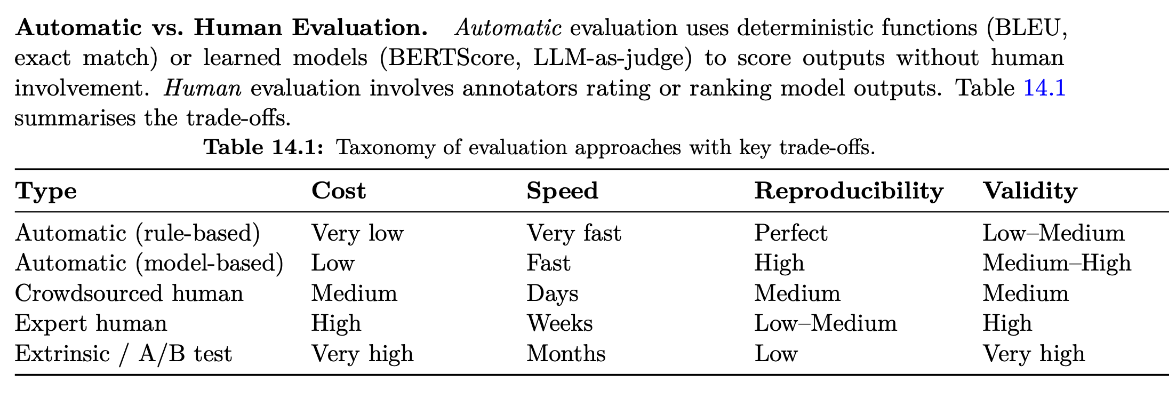
Roitman, Haggai. “The Hitchhiker’s Guide to Agentic AI: From Foundations to Systems.” arXiv preprint arXiv:2606.24937 (2026).
Keypoints
Simply speaking, the evaluation methods fall into either of these kinds:
Reference-based evaluation has some gold standard to compare to. Here the space of agreeable answers is typically small (e.g., yes/no answers, distance metrics etc.)
Reference-free evaluation doesn’t have a reference data-point, instead relies on something giving a judgement like human raters or LLM-as-a-judge.
If you can formulate your problem as reference-based, it will often make development easier, but with certain trade-offs.
Benchmarks
What a benchmark is
A benchmark is a fixed set of tasks with known answers, together with a scoring procedure. It works like a standardised exam: every model answers the same questions and receives a score, usually accuracy.
Most benchmarks use the methods described above. Multiple-choice benchmarks use exact match, coding benchmarks use unit tests, and some newer benchmarks use an LLM judge.
Benchmarks are the most common way to compare models. Model releases usually include a table of benchmark scores, and public leaderboards rank models by them.
Common benchmark families
The table lists a few well-known examples. It is not a complete list, and new benchmarks appear frequently.
Capability |
Example benchmarks |
What is tested |
|---|---|---|
General knowledge |
MMLU, MMLU-Pro |
Multiple-choice questions across dozens of academic and professional subjects |
Expert-level questions |
GPQA |
Difficult science questions written to be hard to answer with a web search |
Mathematical reasoning |
GSM8K, MATH |
Word problems and competition-style problems with a checkable final answer |
Code |
HumanEval, SWE-bench |
Writing functions that pass tests; fixing real issues in open-source repositories |
Instruction following |
IFEval |
Following checkable instructions, such as “answer in fewer than 100 words” |
Truthfulness |
TruthfulQA |
Avoiding popular misconceptions |
Safety |
Toxicity and bias test sets |
Avoiding harmful or discriminatory outputs |
Tools such as EleutherAI’s lm-evaluation-harness run many of these
benchmarks through a common interface, which makes it easier to evaluate a
model locally.
Why a benchmark score is not intelligence
Benchmarks are useful, but a high score does not mean that a model “knows” or “understands” a subject in the way a person who passed the same exam would. There are several reasons for this.
Contamination
LLMs are trained on very large collections of text from the internet. Benchmark questions and answers are often published online, so they can end up in the training data. A model may then answer correctly because it has seen the answer, not because it can solve the problem.
This is similar to a student who memorised last year’s exam. Contamination is difficult to rule out, because the training data of most models is not fully disclosed.
Saturation
When most strong models score above 90% on a benchmark, the remaining differences are small and often within noise. The benchmark no longer separates good models from very good ones. This has happened to several popular benchmarks, which is why harder replacements keep being created.
Brittleness
Benchmark performance can depend on surface details. A model may answer a question correctly in one phrasing and fail when the question is reworded or the answer options are reordered. A score on a fixed set of phrasings may overestimate how reliably the model handles the underlying skill.
Poor reproducibility
The reported score depends on many choices besides the model:
the exact prompt wording and chat template;
the number of worked examples included in the prompt (few-shot or zero-shot);
the sampling settings;
how the answer is extracted from the generated text;
the version of the benchmark and of the evaluation code.
Two teams evaluating the same model with slightly different settings can obtain noticeably different scores. Scores from different sources are therefore often not directly comparable.
Optimising for the score
When a benchmark becomes important, developers are tempted to optimise for it directly, for example by training on similar questions. This is an example of Goodhart’s law: when a measure becomes a target, it stops being a good measure. Public leaderboards have had to replace their benchmarks for this reason.
A narrow sample
A benchmark covers a limited set of tasks, formats, and languages, often multiple-choice questions in English. Your application is probably different. A model that ranks first on a general benchmark is not necessarily the best choice for extracting fields from Swedish invoices.
Reading a benchmark result
When you see a benchmark score, it helps to ask:
Which version of the benchmark was used, with which prompt and settings?
Were all compared models evaluated under the same conditions?
Is the difference between models larger than the expected noise?
Could the benchmark data have been included in training?
Is the benchmark close to saturation?
Does the benchmark actually test something my application needs?
Benchmarks are a starting point
Benchmarks are useful for shortlisting models and for detecting large changes in general capability. They do not replace an evaluation built from examples of your own task.
Evaluating in languages other than English
Most evaluation resources were built for English. Evaluating a model in another language, such as Swedish, adds some specific difficulties:
Translated benchmarks can mislead. Machine translation introduces errors and unnatural phrasing, and questions about one country’s history or institutions do not test the same knowledge in another culture. A translated benchmark may also reward a model that reasons in English and only produces Swedish words.
Correct is not the same as natural. A model can write grammatically correct Swedish that no native speaker would use, for example translating “I am passionate about” literally as “Jag är passionerad om” instead of the idiomatic “Jag brinner för”. Automatic metrics and LLM judges often miss this; native speakers notice it immediately.
LLM judges share the same bias. A judge trained mostly on English may accept English-sounding Swedish as good.
Tokenisers favour English. Words in other languages, especially long compound words, are often split into more tokens. This makes generation more expensive and uses more of the context window.
Evaluation sets are smaller. Fewer annotators and less existing data mean smaller test sets, so differences of a few percentage points may not be meaningful.
Language-specific suites help. For example, EuroEval (previously ScandEval) covers Swedish and other European languages. Where naturalness and cultural knowledge matter, a sample of the outputs should still be reviewed by native speakers.
Evaluating a fine-tuned model
The methods in this section fit together when evaluating a model we have fine-tuned ourselves. The practical evaluation is described in fine-tuning large language models and in choosing an adaptation strategy. In summary:
held-out task set
    -> measures whether the target behaviour improved
       (verifiable checks, human evaluation, or a validated LLM judge)

comparison with baselines
    -> shows that the improvement came from fine-tuning,
       not from a better prompt or retrieval setup

regression set and selected general benchmarks
    -> shows whether other capabilities became worse
General benchmarks are most useful here as a warning signal. A large drop on a general benchmark after fine-tuning suggests that the model lost capabilities. A small gain, on the other hand, is not evidence that the application improved.
Summary
Evaluating a generative language model is difficult because many answers can be correct, quality has several dimensions, and results depend on the evaluation setup.
Each evaluation method answers a different question:
Loss and perplexity show how well the model predicts text, but not whether it is useful.
Reference-based metrics are cheap, but word overlap does not capture meaning.
Verifiable checks are reliable and reproducible, but only exist for tasks with checkable outcomes.
Human evaluation is the closest to a gold standard, but it is slow, expensive, and limited to small samples.
LLM-as-a-judge scales to open-ended tasks, but it has systematic biases and must be validated against human judgement.
Preference rankings reflect real user prompts, but combine many dimensions into one score and depend on who votes.
Benchmarks are the most common way to compare models. They are useful, but contamination, saturation, brittleness, poor reproducibility, and optimisation for the score mean that a benchmark result is not a direct measure of a model’s intelligence. For non-English use, these problems are stronger, and native-speaker review remains important.
The most reliable evaluation of an adapted model is built from representative, held-out examples of the intended task, compared against meaningful baselines.